A beauty professional’s salon station is a workplace, a marketing asset and an infection-control checkpoint at the same time. Clients read it in about three seconds and draw conclusions they will never say out loud. State Board inspectors read it too — and they do say it out loud.
These seven salon station habits come from working salon floors and from California Board of Barbering and Cosmetology requirements. They apply whether you are a student on a clinic floor, a booth renter, or running a suite of your own.
1. Reset Between Every Single Client
The professional standard is not “tidy at the end of the day”. It is a full reset in the two minutes between clients: tools disinfected and put away, hair swept, capes changed, surfaces wiped, product returned to its place.
- Keep a covered container of EPA-registered disinfectant solution at the station.
- Sweep immediately — hair on the floor is both a slip hazard and an instant Board violation.
- Wipe the chair, headrest and armrests with a disinfectant wipe in front of the next client. Visible sanitation is reassurance.
2. Separate Clean From Dirty — Physically
This is the principle inspectors care about most. Disinfected implements must be stored in a clean, closed, labeled container. Used implements go into a separate labeled container until they are cleaned and disinfected.
- Two containers, clearly labeled “Clean / Disinfected” and “Used / To Be Disinfected”. Never one drawer for both.
- Single-use items — files, buffers, applicators, neck strips — go straight in the bin after one client. No exceptions.
- Store clean linens covered; store used linens in a closed receptacle.
- Never place tools directly on a bare countertop; use a clean towel or tray.
3. Build a Zone System
Give every category a fixed home so your hands find things without your eyes. A workable layout is: dominant-hand zone for shears, combs and clips; secondary zone for product; back or lower zone for backup stock and personal items; and a designated dead zone that stays permanently clear as working space.
The rule of thumb is that anything used on more than half your clients lives within arm’s reach. Everything else goes in a drawer.
4. Contain Everything in Drawers and Trays
Open drawers become junk piles within a fortnight. Drawer dividers, small acrylic bins and a rolling trolley are the difference between a station that stays organized and one that has to be rescued every Friday.
- Magnetic strips or a shear holder keep blades protected and off the counter.
- Clear containers so you can see stock levels without opening anything.
- Label the outside of drawers — especially in a shared or student environment.
- A rolling trolley moves the tools you need to the client rather than the other way round.
5. Keep the Counter Nearly Empty
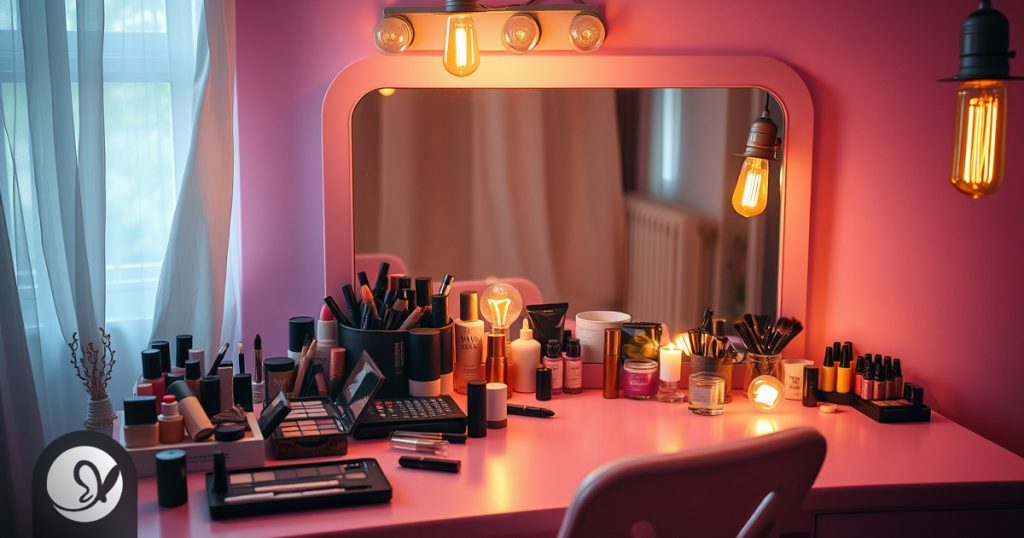
The most professional-looking stations are the emptiest. A mirror, a clear working surface, one or two retail pieces displayed deliberately, and nothing else. Every extra object adds visual noise, collects product overspray and creates another surface to disinfect.
Personal items — phone, drink, bag, food — belong out of the client area entirely. In California, eating and drinking in the service area is a violation, not a style choice.
6. Maintain Tools on a Schedule, Not on Failure
- Clean hair and product from clipper blades daily; oil them at the end of each day.
- Wipe shears after every client and dry them thoroughly; corrosion starts at the pivot.
- Have shears professionally sharpened every four to six months; a dull blade damages hair and your wrist.
- Wash brushes and combs weekly and disinfect between clients.
- Check cords for fraying and retire any tool with damaged insulation immediately.
7. Run a Weekly and Monthly Deep Clean
Weekly: empty and wipe every drawer, restock backbar and single-use items, check disinfectant expiry dates, launder capes and towels, and consolidate half-empty product bottles.
Monthly: audit stock against what you actually used, discard expired product, deep clean the trolley and chair base, and review whether your zone layout still matches how you work. Stations should evolve as your services do.
Why This Is Taught, Not Assumed
Sanitation, disinfection and station setup are examinable subjects. California’s written State Board exam tests infection control, and inspectors can and do issue citations for improperly stored implements, hair on the floor and unlabeled containers. Students on our clinic floor work to salon standard from week one — it is a graded part of the cosmetology program, the esthetician course and the manicuring program alike.
If you are considering training, our guide to choosing a beauty school in Los Angeles explains what a proper clinic floor should look like when you tour one.
Frequently Asked Questions
How often should I disinfect my tools?
Any implement that touches a client must be cleaned and disinfected before it touches the next one. Single-use items are discarded after one client.
What is the difference between sanitizing and disinfecting?
Sanitizing reduces the number of microbes; disinfecting kills them on a hard, non-porous surface. Boards require an EPA-registered disinfectant, used at the correct dilution and contact time.
Can I keep my phone at my station?
Keep it out of the service area. Phones are among the most contaminated objects people carry, and handling one mid-service breaks the sanitation chain.
What is the fastest way to reset between clients?
Sweep, dispose of single-use items, drop used implements in the “used” container, wipe the chair and counter, lay a clean towel with the next set of tools. Two minutes, in the same order every time.
Do inspectors really check this?
Yes. Improper implement storage, hair on the floor, unlabeled containers and expired disinfectant are among the most commonly cited violations.
The Bottom Line
An organized station is faster, safer and quietly persuasive. Reset between every client, keep clean and used implements physically separate, give everything a fixed home, and deep clean on a schedule. Do that and you will pass any inspection and look like the professional you are — talk to our admissions team if you want to build these habits properly from day one.