The short answer
Cosmetology school in Los Angeles takes 1,000 hours of state-approved training, costs roughly $12,000 to $20,000, and ends with a single written exam — California removed the practical exam. Full-time students typically finish in 8 to 10 months; evening students in 12 to 16. Your license lets you work legally with hair, skin and nails anywhere in California.
Key takeaways
- California requires 1,000 hours of practical and technical instruction for a cosmetologist license — down from 1,600 hours before the 2022 reform.
- You must be at least 17 years old and have completed the 10th grade or its equivalent. No high school diploma or college degree is required.
- There is no practical exam in California anymore. The cosmetologist written exam runs 120 minutes.
- Los Angeles tuition for a full cosmetology program generally lands between $12,000 and $20,000, usually including a professional kit.
- The choice that matters most is not the school’s marketing — it’s clinic floor time, instructor-to-student ratio, and whether the schedule fits the life you actually have.
What this guide covers
- What cosmetology school in Los Angeles actually involves
- What California requires before you enroll
- The 1,000 hours, broken down by subject
- How long it takes: day school vs. evening school
- What it costs in Los Angeles — the complete number
- How to choose a school: 10 questions
- What a real week looks like
- The California state board exam
- After you’re licensed: careers and earnings in LA
- Cosmetology vs. the other three California licenses
- How to enroll
- Frequently asked questions
1. What cosmetology school in Los Angeles actually involves
A cosmetology program is not a series of lectures with a certificate at the end. It is a licensed vocational program regulated by the California Board of Barbering and Cosmetology, and the state counts your hours the way an airline counts flight time. You clock in, you clock out, and the hours only count if the school is state-approved.
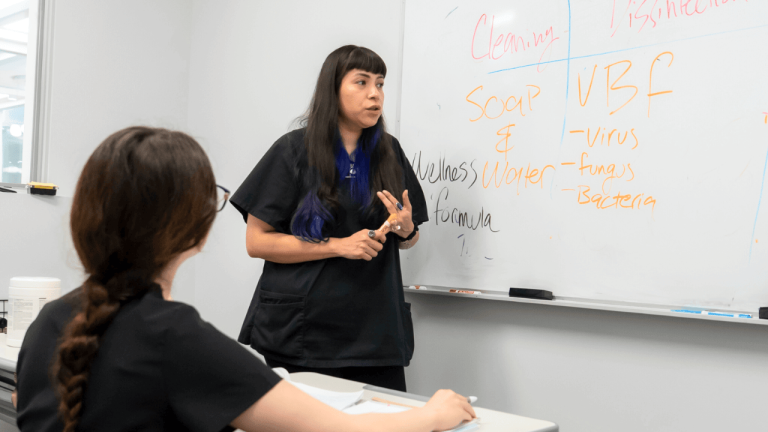
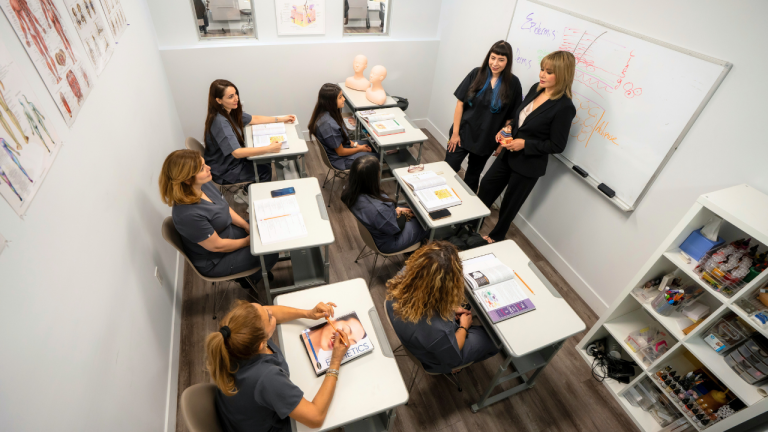
The structure is roughly the same at every approved school in Los Angeles, because the state defines it. You spend the first stretch in theory and on mannequins — sanitation, safety, hair structure, sectioning, basic cutting. Then you move to the clinic floor, where you work on real members of the public at reduced prices under an instructor’s supervision. That clinic floor is where the actual learning happens, and it is the single biggest quality difference between schools.
What varies from school to school is not the curriculum outline. It is how many hours you actually spend with shears in your hand, how many students share one instructor, how busy the clinic floor is, and whether the school still teaches to the modern LA market — balayage, textured hair, editorial work, men’s cutting — or to a syllabus written twenty years ago.
A note on “online cosmetology school.” You will see ads for it. California does not accept fully online hours for a cosmetology license. A limited portion of theory may be delivered remotely at some schools, but the practical hours must be earned in person at an approved facility. If a program promises a California license entirely online, it cannot deliver one.
2. What California requires before you enroll
The entry bar is deliberately low, because cosmetology is a trade license, not an academic degree. According to the California Board of Barbering and Cosmetology, you need to be:
- At least 17 years old. You can enroll and train at 17 and sit the exam once you meet the hour requirement.
- A 10th-grade graduate or equivalent. A high school diploma is not required. A GED, a transcript showing completion of tenth grade, or an equivalency evaluation for foreign education all satisfy this.
That is the entire state requirement. Individual schools may ask for a photo ID, a Social Security number or ITIN for exam registration, and a signed enrollment agreement. Some ask for a short interview — which is worth taking seriously, because a school that never talks to you before taking $16,000 is telling you something about how it will treat you afterward.
What you do not need
- A high school diploma or college credits
- Any prior beauty experience
- Your own tools before day one — a program should supply a kit
- U.S. citizenship (though visa status affects eligibility for federal aid, not for licensure)
3. The 1,000 hours, broken down by subject
California doesn’t just say “1,000 hours.” It specifies minimum hours per subject area. Here is what the Board requires inside a cosmetology program:
| Subject area | Minimum hours | What it actually means |
|---|---|---|
| Health and safety | 100 | Chemistry of products, hazardous substances, ergonomics, communicable disease, client health screening |
| Disinfection and sanitation | 100 | Tool disinfection, station setup, Board regulations, bloodborne pathogen protocol |
| Chemical hair services | 200 | Color, bleach and toner, perms, relaxers, patch testing, corrective color |
| Hairstyling services | 200 | Cutting, blow-dry and thermal styling, updos, extensions, men’s cutting |
| Skin care services | 150 | Facials, cleansing, extractions, masks, makeup application |
| Hair removal, lashes and brows | 50 | Waxing, brow shaping, lash and brow tinting, lash extensions |
| Manicure and pedicure | 100 | Natural nail care, gel, acrylic, pedicure protocol, nail disorders |
| Specified subtotal | 900 | |
| Remaining hours | 100 | Allocated by the school — usually extra clinic floor time, business skills, or a specialty track |
Source: California Board of Barbering and Cosmetology, license requirements.
That last row is worth pausing on, because it is where schools differentiate themselves. One hundred hours is roughly three full weeks. A school that spends them on additional clinic floor time, salon business training, or a modern color specialization is giving you something real. A school that quietly spends them on more mannequin work is not.
For the full legal detail on hour requirements, exam eligibility and the paths that let you count out-of-state or apprenticeship experience, see our dedicated guide to California cosmetology license requirements.
4. How long it takes: day school vs. evening school
One thousand hours is a fixed number. What changes is how fast you burn through it. In Los Angeles, most approved schools run two tracks:
| Track | Typical hours | Hours per week | Time to 1,000 hours | Who it suits |
|---|---|---|---|---|
| Day program | 9:00 am – 3:00 pm, Mon–Fri | ~30 | 8–10 months | Students without a full-time job; career changers using savings or a payment plan |
| Evening program | 5:00 pm – 9:00 pm, Mon–Fri | ~20 | 12–16 months | People keeping a day job, parents with daytime childcare needs |
| Part-time / weekend | Varies by school | 10–16 | 18–24 months | Students paying as they go; not offered everywhere |
The honest trade-off: evening programs let you keep your income, but they stretch the finish line by four to six months, and a longer program means more months of tuition payments before you can earn from the license. Day programs get you earning sooner but require you to either save first or use a payment plan.
At Elite, the 1,000-hour cosmetology program runs both tracks: days from 9:00 am to 3:00 pm and evenings from 5:00 pm to 9:00 pm, so you can pick the one that matches the life you have rather than the one the school prefers to staff.
Attendance is not optional in the way school usually is
Because the state counts hours rather than semesters, missing a week doesn’t lower your grade — it pushes your graduation date back by a week. Schools track this precisely, and most enrollment agreements include an attendance policy with real consequences. Before you sign anywhere, ask what happens to your schedule and your tuition if you miss two weeks for illness or a family emergency.
5. What it costs in Los Angeles — the complete number
Tuition is the headline, but it is not the whole number. Here is the full picture for a Los Angeles cosmetology program:
| Line item | Typical LA range | Notes |
|---|---|---|
| Tuition (1,000 hours) | $12,000 – $20,000 | Elite’s program is $16,900 |
| Professional kit | Often included | Shears, clippers, mannequins, color tools, skincare and nail supplies |
| Textbooks and materials | $0 – $500 | Frequently bundled into tuition |
| State exam and application fees | ~$125 – $200 | Paid to the Board, not the school; verify current amounts at barbercosmo.ca.gov |
| Replacement supplies during training | $200 – $600 | Color, extra mannequins, product you choose to buy |
| Transport and parking | Varies | Real money in LA — factor the commute into your school choice |
Two things reshape that number more than any discount:
Payment plans. Most private LA beauty schools offer in-house monthly payment plans, which spread tuition across the length of the program rather than requiring it upfront. This is often the difference between enrolling this year and enrolling in three years. Ask for the plan in writing: down payment, monthly amount, total paid, and what happens if you withdraw.
What’s included. A $14,000 program that excludes a $1,200 kit and $400 of books is not cheaper than a $16,900 program that includes both. Get an itemized total before you compare.
Our full breakdown of every cost — including state fees, hidden extras and how payment plans actually work — is in How much does beauty school cost in California.
6. How to choose a school: 10 questions that separate the good from the glossy
Every school’s website has smiling students and a hero video. These ten questions get past that. Ask them on your campus tour, and write down the answers.
- Are you approved by the Bureau for Private Postsecondary Education, and what is your school code? You can verify any California school independently at the BPPE’s public lookup. A school that hesitates here is disqualifying itself.
- What is your instructor-to-student ratio on the clinic floor? The state sets a maximum. The number that matters is the real one on a busy Thursday afternoon.
- How many hours of my 1,000 will be on live clients? More is better. This is the number that determines whether you graduate confident or terrified.
- Can I see your School Performance Fact Sheet? California requires this document. It contains completion rates, exam pass rates and job placement rates. It is the most honest page any school will ever hand you.
- What is your state board exam pass rate? Compare against the state average, not against zero.
- What exactly is in the kit, and do I own it? Some schools loan tools back. You want to graduate owning your shears.
- Who teaches, and when did they last work behind a chair? An instructor who left the floor in 2009 will not teach you 2026 color.
- What happens if I need to pause? Life happens over 10 to 16 months. Get the leave-of-absence policy in writing.
- What does job placement support actually consist of? “We help with placement” can mean a job board or it can mean a relationship with twenty salons. Ask which.
- Can I sit in on a class before I enroll? A confident school says yes.
7. What a real week looks like
Prospective students almost always underestimate the physical side and overestimate the academic side. Here is a realistic composite of a mid-program week in a day track — assembled from how the schedule typically runs, not from any one student’s diary.
| Day | Morning | Afternoon |
|---|---|---|
| Monday | Theory: hair color chemistry, level and tone systems | Mannequin work — foil placement drills |
| Tuesday | Clinic floor: two blow-dry and style clients | Clinic floor: single-process color under supervision |
| Wednesday | Sanitation review and station inspection | Skin care rotation: facial protocol and extractions |
| Thursday | Clinic floor: haircut clients, instructor checks each section | Nail rotation: gel application and cuticle work |
| Friday | Written quiz on the week’s theory | Open clinic floor — walk-in clients, fastest learning of the week |
What surprises people: your feet and shoulders, not the exams. You are standing for most of six hours with your arms raised. Students who come from desk jobs consistently name this as the hardest adjustment of month one. Invest in real shoes before day one, not after week three.
A composite student picture
Consider a 29-year-old who has been managing a coffee shop in Culver City for six years and wants out. She enrolls in an evening program so she can keep working days, clocking about 20 hours a week. Month one is exhausting and she considers quitting twice. By month four she is on the clinic floor and coloring hair for real people. By month nine she has a small book of friends-of-friends who come to the school clinic and ask for her by name. She finishes in month fourteen, passes the written exam six weeks later, and starts as an assistant at a Santa Monica salon at an hourly wage plus tips — earning less than she did managing the coffee shop, for about eight months, before her own column fills up.
That last sentence is the part most schools leave out, and it is the part worth planning for. The license is the start of the career, not the payoff.
8. The California state board exam
This is where a lot of outdated advice circulates online. Here is the current position:
- There is no practical exam. California eliminated the hands-on practical examination. You are not tested on a mannequin in front of an examiner.
- The cosmetologist written exam is 120 minutes. For estheticians, manicurists, hairstylists and electrologists it is 90 minutes.
- You apply through BreEZe, the Department of Consumer Affairs’ online licensing system, and schedule your exam date after your application is approved.
- The exam covers health and safety, disinfection and sanitation, and the technical subject areas listed in the hours table above — weighted roughly in proportion to those hours.
The practical implication: the exam rewards students who took the theory portion seriously, not just the ones with the best hands. Every year, strong stylists fail on sanitation regulations because they treated theory as the boring part. Our step-by-step preparation guide is at How to pass the California cosmetology written exam.
9. After you’re licensed: careers and earnings in LA
A California cosmetology license is the broadest of the four beauty licenses. It legally covers hair, skin and nails, which means it opens the widest set of doors:
- Salon stylist — assistant, then commission stylist, then booth renter
- Colorist or texture specialist
- Freelance and editorial work — film, television, music video and photo shoots, an unusually large market in Los Angeles
- Bridal and event hair
- Esthetics and makeup within a full-service salon
- Salon management or ownership
- Manufacturer education and platform artistry
- Cosmetology instructor, after additional requirements
On earnings, be skeptical of any school that quotes you a single confident number. Beauty income in Los Angeles is a stack: hourly or commission, plus tips, plus retail commission, minus booth rent if you rent. It varies enormously by neighborhood, specialty and how quickly you build a client book. For current figures, look at the Bureau of Labor Statistics occupational wage data for the Los Angeles–Long Beach–Anaheim metro area rather than any school’s brochure. We break down the components in How much do cosmetologists make in Los Angeles.
10. Cosmetology vs. the other three California licenses
Cosmetology is the longest and most expensive of the four. That is only the right choice if you want the breadth. Here is the honest comparison:
| License | State-required hours | Written exam | What it lets you do | Best for |
|---|---|---|---|---|
| Cosmetologist | 1,000 | 120 min | Hair, skin and nails | Maximum flexibility; anyone unsure which direction they’ll go |
| Esthetician | 600 | 90 min | Skin care, facials, waxing, lashes and brows | Skincare and spa focus; a faster, cheaper route into the industry |
| Hairstylist | 600 | 90 min | Cutting and styling only — no color, bleach or perms | People certain they only want to cut and style |
| Manicurist | 400 | 90 min | Manicures, pedicures, nail enhancements | Fastest and least expensive entry into a licensed beauty career |
If you are genuinely torn, the deciding question is not “which is cheapest” but “how sure am I?” Cosmetology costs more and takes longer, but it means you never have to go back to school because you discovered you love skin more than hair. If you are certain, the specialist licenses get you earning months sooner and thousands of dollars cheaper.
The detailed comparisons are here: esthetician vs. cosmetologist and hairstylist vs. cosmetologist vs. barber.
11. How to enroll at Elite Cosmetology College
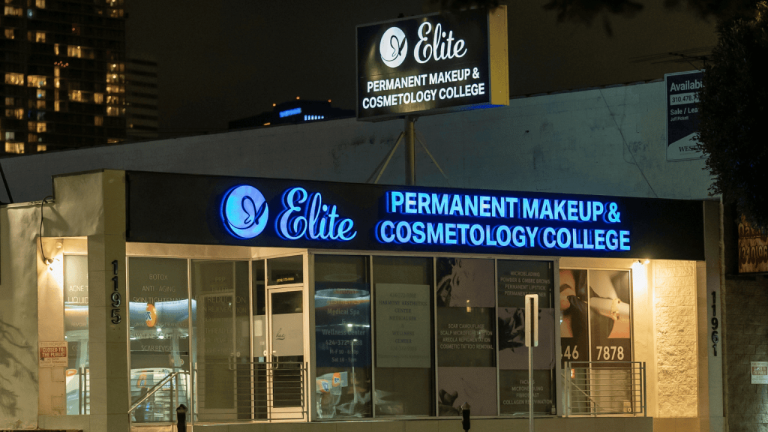
Elite is located at 11961 Santa Monica Blvd in West Los Angeles, which puts it within a short drive of Santa Monica, Westwood, Brentwood, Culver City and Beverly Hills. The 1,000-hour cosmetology program runs both day and evening tracks, tuition is $16,900 with a payment plan available, and the professional kit is included.
The enrollment path is straightforward:
- Book a campus tour and sit in on a class
- Review the School Performance Fact Sheet and the enrollment agreement
- Choose your track — days 9:00 am to 3:00 pm, or evenings 5:00 pm to 9:00 pm
- Set up your payment plan
- Start on the next cohort date
See the full cosmetology program details and enroll → · Or call 310-446-7878 to speak with admissions.
Frequently asked questions
How many hours is cosmetology school in California?
1,000 hours of practical and technical instruction at a state-approved school. This was reduced from 1,600 hours in a 2022 reform, which makes older articles and forum posts unreliable on this point.
How long does cosmetology school take in Los Angeles?
About 8 to 10 months on a full-time day schedule of roughly 30 hours a week, or 12 to 16 months on an evening schedule of about 20 hours a week.
Do I need a high school diploma for cosmetology school in California?
No. California requires completion of the 10th grade or its equivalent, and a minimum age of 17. A diploma is not required, though individual schools may set their own additional standards.
Is there still a practical exam for the California cosmetology license?
No. California eliminated the hands-on practical examination. Licensure now requires passing a written examination, which runs 120 minutes for cosmetologists.
Can I do cosmetology school online in California?
Not for the full license. California requires practical hours to be earned in person at an approved facility. Programs advertising a complete online path to a California cosmetology license cannot deliver one.
How much does cosmetology school cost in Los Angeles?
Generally $12,000 to $20,000 in tuition, usually including a professional kit, plus roughly $125 to $200 in state application and examination fees paid directly to the Board. Elite’s program is $16,900 with a payment plan available.
Can I work while attending cosmetology school?
Yes, and many students do — that is what evening programs exist for. A 20-hour evening schedule leaves daytime hours open, at the cost of extending the program by roughly four to six months.
Can I cut men’s hair with a California cosmetology license?
Yes. A cosmetology license covers hair services for all clients, including men’s cutting and clipper work. A separate barber license adds shaving with a straight razor, which cosmetology does not cover.
What if I trained in another state?
California allows out-of-state practice to count toward eligibility at a rate of 100 hours per three months of documented experience. The specifics depend on your documentation — see transferring hours between beauty schools.
Next steps
- Cosmetology program at Elite — 1,000 hours, day and evening, $16,900 with payment plan
- Compare all four programs side by side
- Full cost breakdown for California beauty school
- California cosmetology license requirements in detail
- Start your enrollment
Reviewed by Mahnaz Bahaelou, Founder, Elite Cosmetology College — 20+ years in the beauty industry. Hour requirements and examination format verified against the California Board of Barbering and Cosmetology, August 2026. Always confirm current fees and requirements at barbercosmo.ca.gov.